
Decision Guide
Pack-Out vs. Cleaning in Place
When pack-out is warranted vs when in-place cleaning works — cost and timeline trade-offs and how insurance handles each approach.
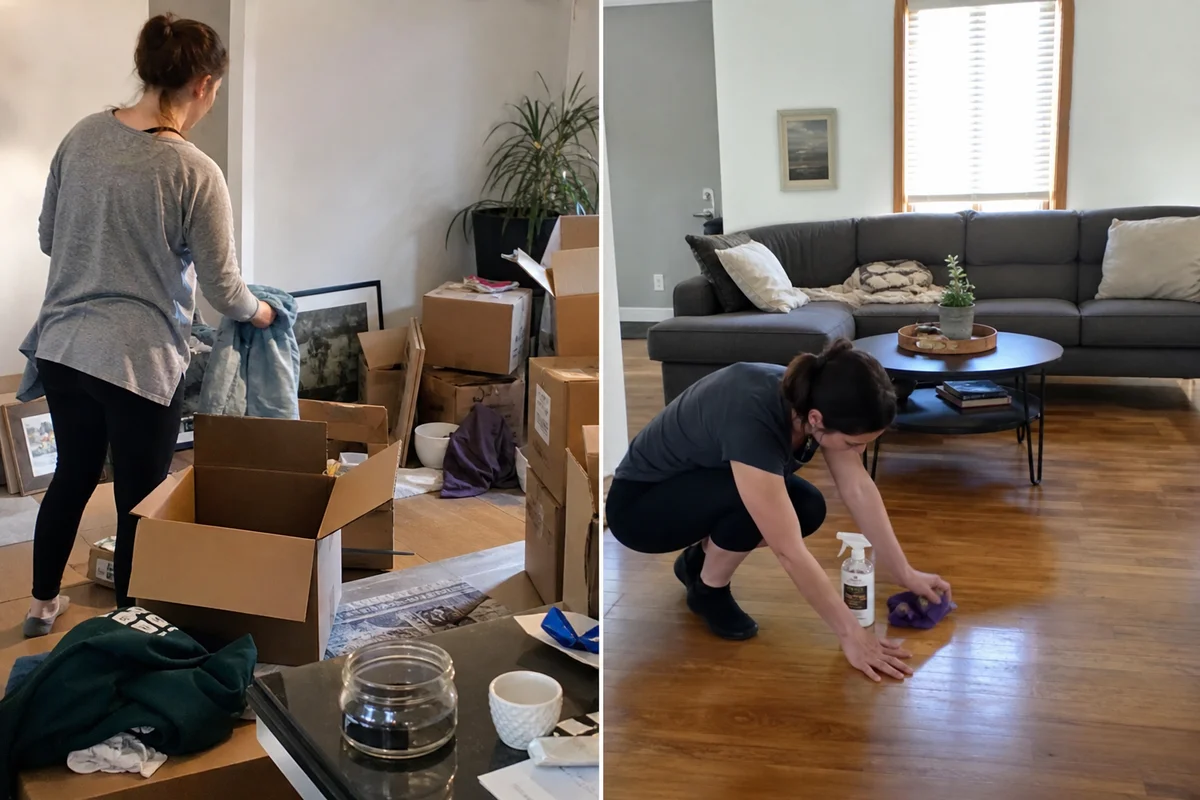
Pack-out is a significant service — it’s not automatic for every restoration job. Sometimes cleaning in place is faster, cheaper, and less disruptive. Here’s how we decide.
When pack-out makes sense
Reconstruction requires access. If we’re removing walls, ceilings, or flooring, contents are in the way. Pack-out clears the space and protects contents from construction dust and debris.
Contents need specialized cleaning. Documents, photos, electronics, textiles, and other items often need off-site cleaning that can’t be done at your home. Pack-out enables that.
Home is unsafe or uninhabitable. During major restoration, some homes aren’t fit for occupation. In these cases, contents need to move somewhere safe too.
Contamination requires containment. For biohazard or Category 3 water jobs, cross-contamination risk from contents to work areas (and vice versa) drives pack-out.
Insurance adjuster requires it. Some adjusters require pack-out documentation for scope approval on larger losses.
When in-place cleaning is better
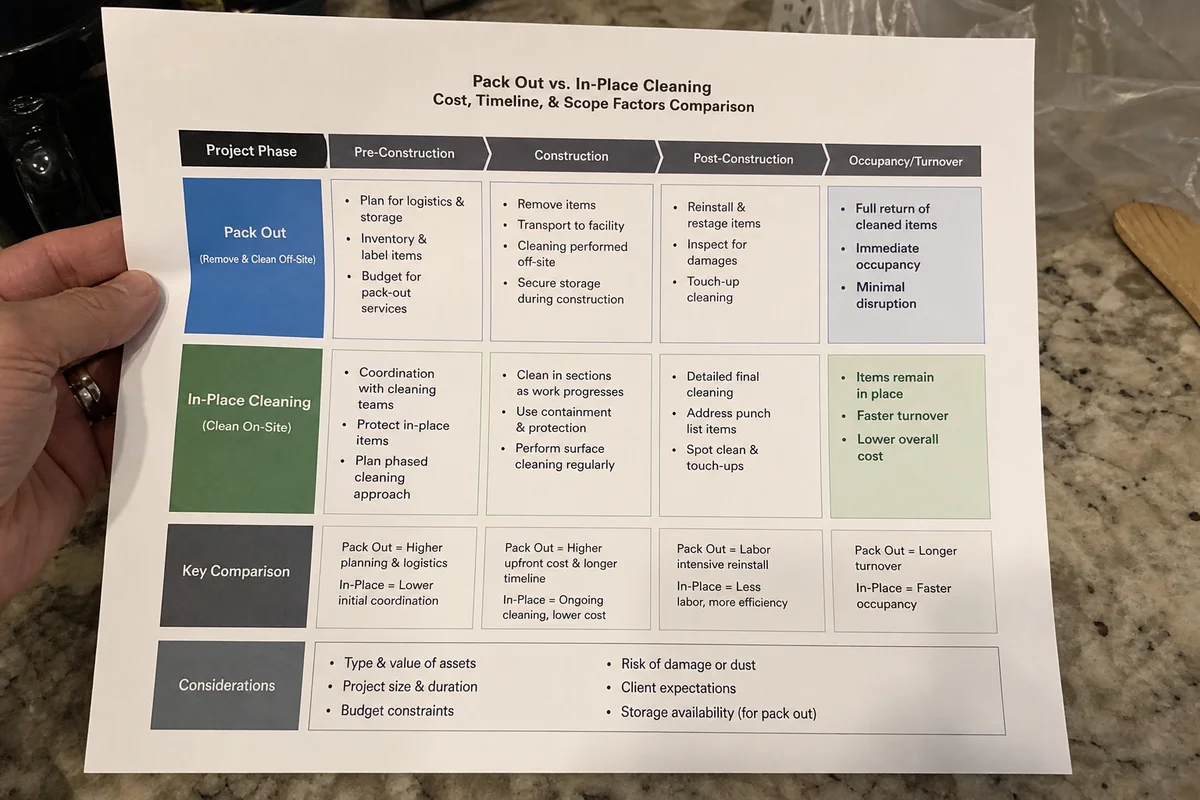
Limited damage. If restoration is confined to a small area, working around contents with plastic sheeting protection is often more efficient.
Short reconstruction timeline. For repairs measured in days rather than weeks, moving contents out and back may create more disruption than it saves.
Occupied home. If you’re staying in the home during work, in-place is often less disruptive than emptying rooms.
Contents can be moved to unaffected areas. If damage is in one room, moving contents to another room in the same home avoids pack-out costs entirely.
Low-value contents. For rental units, storage rooms, or areas with limited valuable contents, in-place is usually the right call.
Cost comparison
In-place cleaning typical costs:
- Wrapping and moving contents around work areas
- On-site cleaning of hard contents
- Content protection during work
- Total: usually 15 to 25% of contents value
Pack-out typical costs:
- Inventory, packing, transport (both directions)
- Off-site cleaning and restoration
- Storage during reconstruction
- Reinstallation
- Total: usually 25 to 45% of contents value
Neither is inherently cheaper — it depends entirely on scope. For a bathroom water damage job affecting a linen closet, in-place is much cheaper. For a whole-basement flood affecting a family room, home office, and guest room, pack-out is often the same cost but produces much better cleaning outcomes.
The decision framework
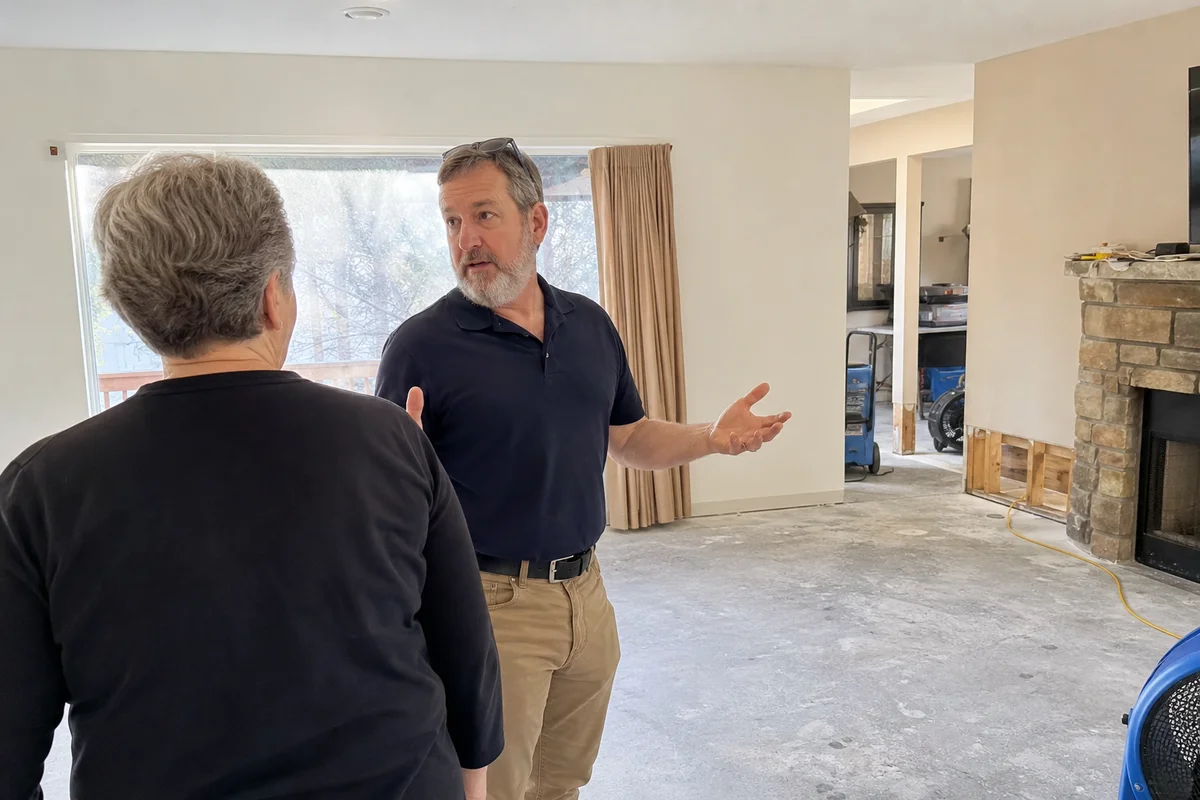
Our estimator walks through:
- Scope of reconstruction — how much of the space needs work?
- Content sensitivity — do items need specialized cleaning?
- Contamination level — clean, gray, or black water? Fire damage?
- Safety — can the home be safely occupied during work?
- Timeline — days, weeks, or months of reconstruction?
- Budget — insurance coverage and any owner budget constraints
- Owner preference — practical considerations for your family
Based on those factors, we recommend one approach or a hybrid (some rooms packed, some cleaned in place).
Hybrid approaches
Common in practice:
- Pack out the basement, clean bedrooms in place — where damage is concentrated in one area
- Pack out high-value items, clean common items in place — art, electronics, and specialty items get off-site treatment; bulk contents stay
- Pack out for the first phase, return before final cleaning — contents come back before final decontamination and deodorization
What insurance covers
Insurance typically covers whichever approach is warranted for the loss. Adjusters generally prefer:
- The most cost-effective option that fully addresses the damage
- Well-documented decisions with clear scope reasoning
- In-place cleaning for straightforward damage
- Pack-out for extensive damage or specialty cleaning needs
We provide Xactimate scope for whichever approach is right and let the numbers speak for themselves.
The middle path
For many jobs, the answer isn’t binary. We might:
- Pack out a few high-value items for specialized cleaning
- Move the rest to unaffected areas of the home
- Clean everything in place after reconstruction
- Return the specialty items last
This kind of tailored approach is common when scope is moderate.
Communication throughout
Whichever approach we take, communication is constant:
- Weekly updates on status
- Clear inventory of what’s where
- Advance notice of upcoming steps
- Immediate contact for anything requiring decisions
Call us
For an honest assessment of what’s right for your loss, call (720) 842-1950. We’ll walk the property and lay out your contents restoration and pack-out options clearly. Related: contents pack-out process and restoring documents, textiles, electronics.