
Learn
Mold Inspection & Air Quality Testing Explained
Visual vs air-sampling inspection, the IEP's role, what results mean, and the value of independent pre- and post-remediation testing.
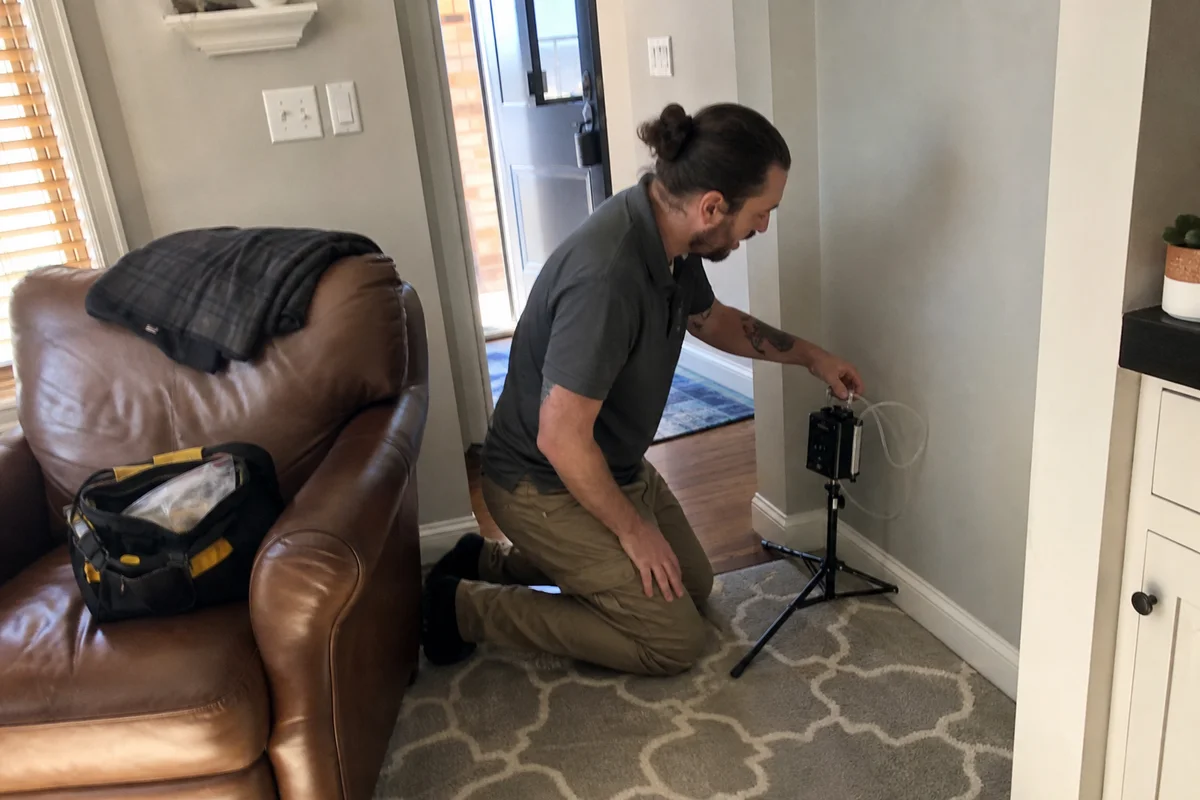
Mold inspection and testing sound like the same thing but are different services. Understanding which you need — and when — saves money and gets you the right information.
Inspection: finding the problem
Inspection is what a certified restoration company does when you call about suspected mold. It’s visual and instrument-based:
- Visual assessment of all accessible areas
- Moisture readings with pin and pinless meters
- Thermal imaging to spot temperature differences from wet materials
- Borescope into wall cavities through small access holes
- Ambient humidity readings to identify condensation-driven growth
Inspection tells you: where is the moisture, where is the visible mold, and what’s the likely cause? It’s non-destructive and typically included in a free assessment.
Testing: characterizing the problem
Testing is lab work. Samples are collected on-site and sent to an accredited laboratory for analysis:
- Air sampling — spore trap cassettes collect airborne spores over a set time period
- Surface swab — cotton swab on a suspect surface
- Tape lift — clear tape pressed to a surface and preserved
- Bulk sample — piece of the material itself sent for analysis
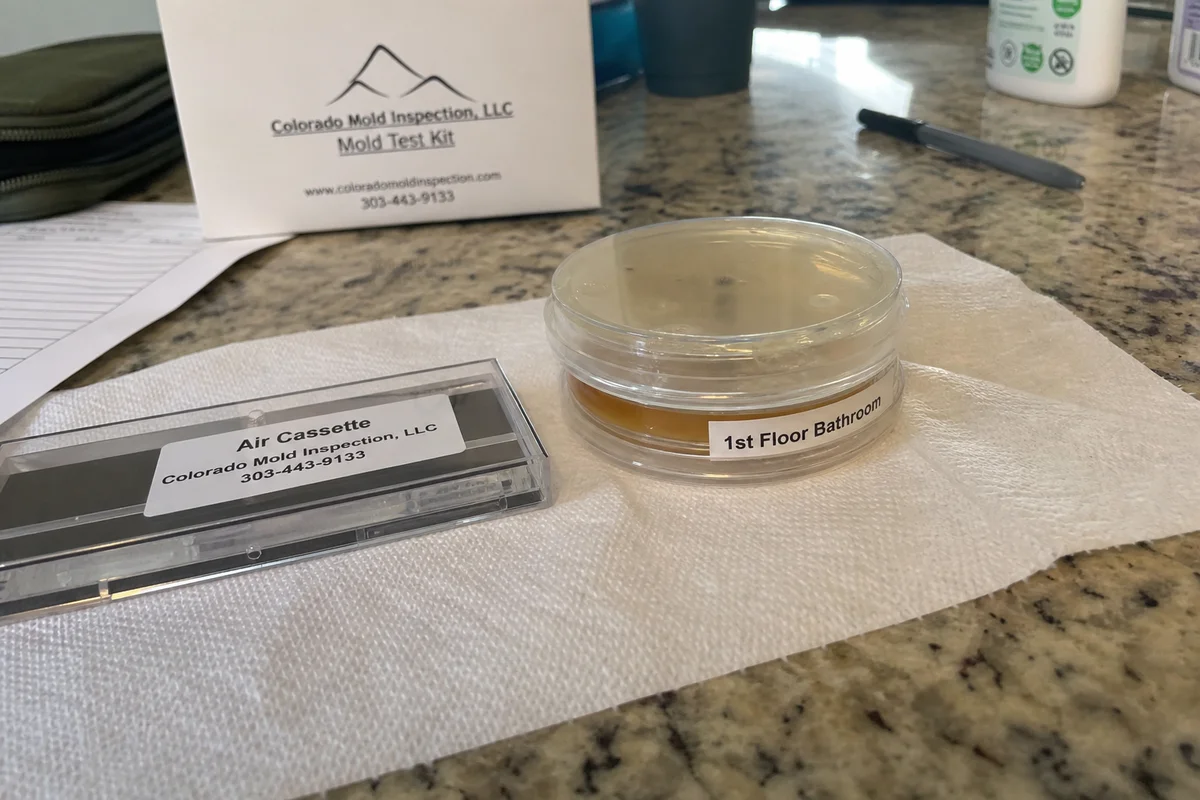
Lab results identify species and spore counts. Testing tells you: what specifically is growing, how much, and how does it compare to outdoor baseline?
The role of the Indoor Environmental Professional (IEP)
Testing is best done by an independent IEP — someone who doesn’t do remediation work. Why? Independence:
- IEP has no financial incentive to find or not find mold
- Test results are objective
- Post-remediation verification carries more weight when done by a party who didn’t do the removal
- Insurance carriers and real estate transactions prefer independent testing
We work with local IEPs when testing is warranted. We don’t collect our own samples for testing on jobs we then remediate — that would be a conflict.
When testing matters
- Suspected hidden mold — you smell it or someone is symptomatic but you can’t see it
- Medical necessity — physician has diagnosed mold-related illness and wants species identification
- Real estate transactions — buyer or seller wants documented status
- Post-remediation verification — proof that remediation returned levels to normal
- Insurance disputes — objective third-party data
- Sensitive occupants — before letting immunocompromised individuals into a remediated space
When testing doesn’t add value
- Visible mold in a known moisture-affected area — you already know what to do
- Small surface patches on hard surfaces — clean, address moisture, monitor
- Testing without an inspection first — you might be sampling in the wrong place
- Repeated testing without change — one baseline and one verification is usually enough
Reading test results
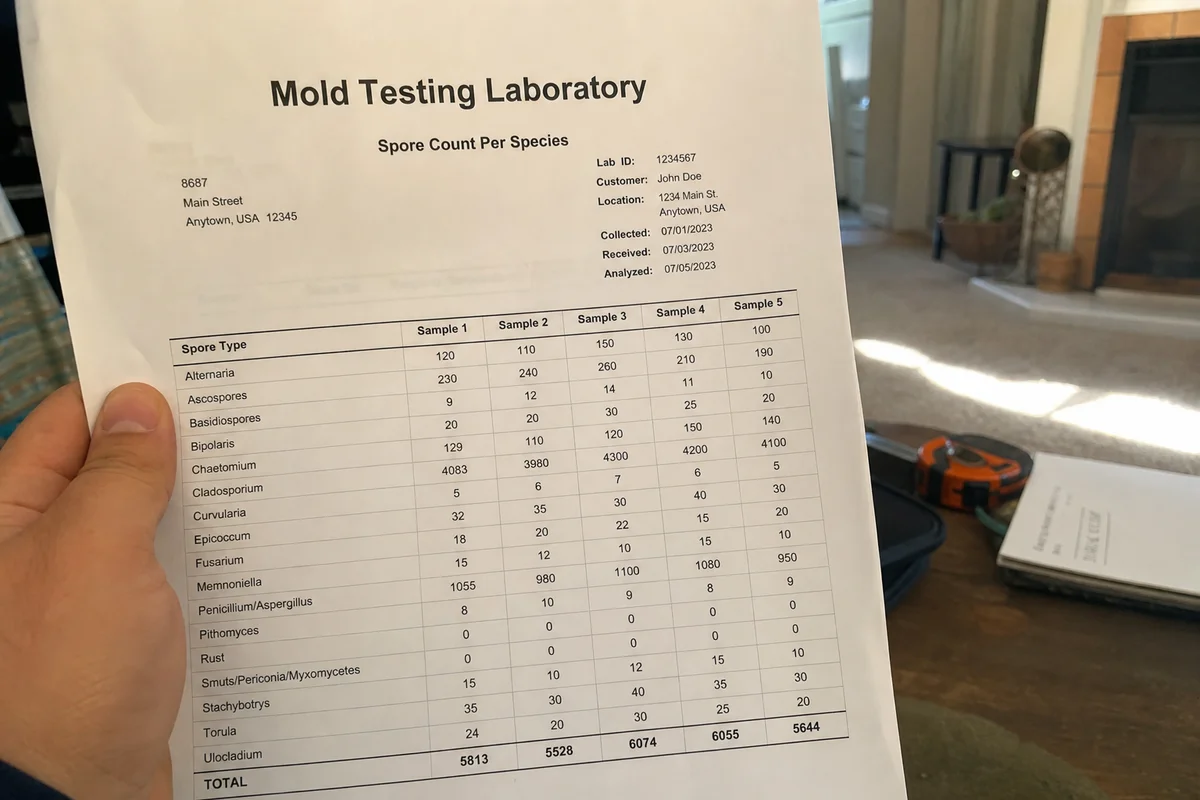
A typical report shows:
- Spore counts by species (in spores per cubic meter of air)
- Comparison to outdoor sample (control)
- Comparison to unaffected indoor areas (control)
- Notes on species significance
The interpretation:
- Indoor counts significantly higher than outdoor = active indoor growth source
- Indoor counts matching outdoor = spores from outside migrating in (normal)
- Presence of specific species (Stachybotrys, Aspergillus, Penicillium in high counts) may warrant attention
There’s no single “safe” number that applies to everyone. Individual sensitivity varies dramatically.
Post-remediation verification
The single most valuable test in our workflow: post-remediation verification (PRV) confirms remediation worked. IEP collects air samples inside the containment area after cleaning. Results compared to outdoor baseline and unaffected areas. If levels match, remediation is verified.
Failed PRV means we go back in and address whatever we missed, then re-test. Homeowners get objective proof — not just our word — that the job is complete.
Cost of testing
- Basic 3-sample air test (indoor + outdoor + affected room): $300 to $500
- Comprehensive 5-6 sample panel: $500 to $900
- Post-remediation verification: $300 to $600
For most residential remediation jobs, one baseline and one verification test are appropriate — total testing cost usually $600 to $1,200.
Bottom line
Inspection is included in most restoration company assessments. Testing is a separate service, usually worth it for hidden mold, medical situations, real estate, or post-remediation verification. Read our mold remediation process guide for how testing fits into remediation.
Call (720) 842-1950 to start with a free inspection, the first step of professional mold remediation.